
There are numerous benefits to cultivating a growth mindset for kids. Learn more and take the first step with the help of these printable worksheets and activities!
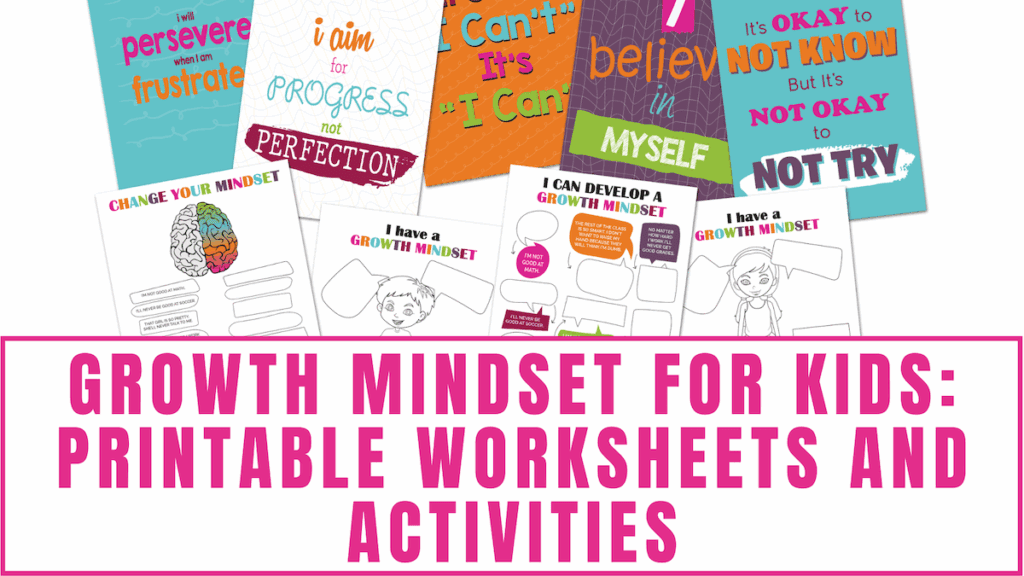
Have you heard the term “growth mindset?” Chances are you have … it’s been around the block a few times. However, you may not know what it really means, why you’d want one, or how to cultivate a growth mindset. Keep reading, because we’re going to get into all of that and more!
In this post, I will focus on a growth mindset for kids, but let me be clear: everyone can benefit from developing a growth mindset. In fact, it could be really cool (and beneficial) to tackle these worksheets and activities as a family.
While there’s never a bad time to work on a growth mindset for kids, I think now is a particularly relevant moment. The back-to-school season is approaching, and with it comes a host of new challenges. A growth mindset can help kids take on these challenges in a less stressful way.
Tip: If you’re a teacher, consider using some of these activities and worksheets at the start of the new school year! They make great first-day-of-school activities for kids of all ages. Helping your students develop a growth mindset is a great way to boost their confidence as the school year kicks off.
What Is a Growth Mindset?
A growth mindset is the belief that your abilities, including intelligence, can be improved through your own efforts. In other words, with hard work, practice, and continued learning, you can improve your skills, whether they involve athletic or academic abilities.
The opposite of a growth mindset is a fixed mindset. When you approach things with a fixed mindset, you approach with the belief that your abilities are static. In other words, your skills in a particular area are what they are and really can’t be improved or changed.

Examples of Growth Mindsets for Kids
Here are two examples of a growth mindset for kids that may help clarify the definition.
Growth Mindset Example 1: Math Class Performance
Fixed Mindset: “I’m just not a math person. I’ll never be good at this, no matter how hard I study or how many tutoring sessions I attend.”
Growth Mindset: “Math doesn’t come naturally to me. I have to work at it, but that’s okay! If I keep practicing, asking questions in class, and using tutoring sessions when needed, I know I can get this.”
Growth Mindset Example 2: Auditioning for a School Play
Fixed Mindset: “I didn’t get the part, so I must not be a talented actor. I should try out for different types of extracurriculars in the future.”
Growth Mindset: “I didn’t get the part, but I learned a lot from my audition and watching other people audition. Next time I’ll prepare differently!”
Benefits of a Growth Mindset for Kids
Now that you know what a growth mindset is, the question is: why spend your time cultivating one? Great question. There are actually numerous benefits of a growth mindset for kids (and adults). According to Mindset Health, here are some of the benefits that you may see when you consistently employ a growth mindset:
- Reduced burnout
- Reduced depression
- Reduced anxiety
- Increased motivation
Additionally, a growth mindset can enhance resiliency in the face of challenges and obstacles.
See why a growth mindset for kids could be so beneficial at the start of a new school year?
How to Develop a Growth Mindset
Good news—there’s no one “right” way to develop a growth mindset for kids. (And also, maybe that’s bad news?)
While it might be easier if there were some correct formula to follow with steps 1 through 10, I think the lack of a set path to follow may make the process of cultivating a growth mindset for kids more fun. You can figure out what works for them.
The first thing to note is that developing a growth mindset requires time and effort. It’s a journey. It will take practice, and you (and your kids) won’t get it right immediately. (And that’s okay!)
Here are five tips to help you develop a growth mindset for kids:
#1 – Practice!
As already mentioned, building a growth mindset will take effort. Practicing, even when you aren’t facing a “real” challenge, will make approaching things with a growth mindset easier when an actual obstacle presents itself. You can practice by using the activities and worksheets in this post.
#2 – Don’t avoid challenges.
Learning to adopt a growth mindset requires you to change how you perceive challenges. Instead of seeing an obstacle as something to be overcome (or worse, something that can’t be overcome), try to see an opportunity to learn and grow!
As you work on your growth mindset, don’t avoid challenges. Putting yourself out there will allow you to assess how your growth mindset is progressing.
#3 – Deploy the word “yet.”
Someone with a growth mindset does not see their skills and abilities as fixed. There is always room for improvement. This means that while you may not be innately good at something or good at something right now, you can always get better.
To help reinforce this, when you face a challenge, reach for the word “yet.” In other words, say things like “I am not good at this yet.”
#4 – Pay attention to your self-talk.
Tied to tip 3, negative self-talk can keep you stuck in a fixed mindset. Pay attention to how you talk to yourself and try to use more positive, appreciative, and supportive language.
#5 – Document your progress.
Since we’re stuck with ourselves all day, every day, sometimes it can be hard to see changes … especially those that aren’t physical. Engage in self-reflection to check your progress toward developing a growth mindset. That might include reviewing the activities and worksheets you complete or journaling about how you approached a new problem.
Bonus: Here are some other things that may help you develop a growth mindset moving forward. (These tips come from Positive Psychology.)
- You need to believe in your ability to grow. If your self-esteem could use a little boost, try these printable self-esteem worksheets.
- Be curious, ask a lot of questions, and commit to learning as a life-long journey.
- Seek out and embrace challenges; get out of your comfort zone.
- Set goals. This printable SMART goals template may help!
Growth Mindset for Kids Worksheets
Excited to help your kids (or students) develop a growth mindset? One easy way to get started is by using the growth mindset activities for kids bundle! Here’s a sneak peek at what’s included.
Change Your Mindset Worksheet

The Printable Growth Mindset vs. Fixed Mindset Activity is a hands-on way to practice deploying a growth mindset for kids. On the left-hand side are fixed mindset statements, such as “I’ll never be good at soccer.” On the right-hand side are blank boxes that invite your child to reframe the statements from a growth mindset.
Bonus: Add an extra challenge to this activity by having your child write one fixed mindset statement they have used recently and then help them reframe it. Doing so will help your kid apply growth mindset activities to real life!
“I Have a Growth Mindset” Worksheets

These 2 Printable Growth Mindset for Kids Worksheets offer a lot of bang for your buck. Not only do they provide the opportunity to practice writing growth mindset statements, but they can also be used as coloring pages. Coloring is a great way to unwind and reduce stress.
Challenge your kids (or students) to write growth mindset statements from scratch that feel relevant to their current goals and challenges.
Tip: If you’re using this activity in a classroom setting, it may be beneficial for students to share one or two of their growth mindset statements with each other.
Growth Mindset Quotes

Okay, this last one is a series of growth mindset quotes you can use to inspire your kids and reinforce the concepts behind having a growth mindset. Get the 5 Printable Growth Mindset Quotes for Kids here.
Place these quotes in high-traffic and high-visibility areas of your home (or classroom) so that your child (and you) see them regularly. Also, when you initially hang them up, take the time to walk your child through each quote and ensure they understand what it means.
Bonus: Place these quotes in your child’s printable student planner to help inspire them throughout the school year!
Have you worked on developing a growth mindset for your kids (or yourself)? What activities did you find helpful? Share your tips and tricks in the comments.


Leave a Reply
You must be logged in to post a comment.