
Set your child (or your students) up for success by creating SMART goals both before and during the school year. This printable SMART goals template is a straightforward and easy-to-implement tool. Additionally, continue reading for specific SMART goal examples for students!
Do you set goals for yourself? How about for your kids (or your students)? If you’re fidgeting nervously and trying to convince yourself that yes, of course, you set goals, relax. You aren’t alone. According to a Gallup poll, only about 70% of Americans set goals, and that percentage tends to drop with age.
And of those people who do set goals, most don’t actually accomplish them. In fact, according to Harvard University, only 8% of people manage to achieve their goals.
The low success rate may lead you to believe that setting goals is a huge waste of time. However, there are numerous benefits to setting goals (especially for kids), and helping your kids get into the habit early on can set them up for success now and in the future!
One way to help your child not only set goals but achieve them is to use a SMART goals template, like the one in this post. SMART goal setting can provide the motivation and clarity necessary to achieve those goals. Once your child has tasted success, I bet they’ll want more, which means setting more SMART goals. Getting the picture?
Continue reading to discover the benefits of goal setting, including more information on what SMART goals are and specific SMART goal examples for students (or kids).
The Benefits of Setting Goals for Students (or Kids)
Setting goals is beneficial for everyone, so while I’ll be focusing on using the SMART goals worksheet for students (or kids), all of this information can also apply to grown-ups.
Learning to set goals and learning how to work toward achieving them are two valuable skills. Full stop. When you help your child master these skills early in life, you are setting them up for success now and in the future. Here are just some of the benefits of goal setting for students:
- Building problem-solving skills. Your child will learn to recognize that there is something they could achieve or optimize and how to break that down into a realistic goal.
- Improving self-confidence. As your child achieves the goals they set, it can improve their self-image and overall confidence.
- Encouraging resilience. As you probably know, things don’t always go as planned. As your child encounters obstacles while working toward their goal, the act of surmounting those challenges can help build resilience. Resilience is correlated with many positive aspects of life, including fewer symptoms of anxiety.
- Increasing self-awareness. As your child sets goals and works toward achieving them, they will develop a better sense of their strengths and weaknesses.
- Knowing how to go from idea to execution. Having an idea or a desire is one thing. Many people want to accomplish something. However, transitioning from a desire or idea to taking action is a skill in itself.
What Are SMART Goals for Students?
Before we get to the SMART goals worksheet, let’s start with the basics.
What even is a goal?
A goal is an outcome toward which effort is directed. In other words, a goal is something you want to happen, and it’s something you’re, in theory, willing to actively expend energy on making happen vs. something you passively wait for. For example, you may want it to snow, but what can you actively do to make that happen? Not much; therefore, “snow” isn’t really a goal.
On the other hand, being able to do 20 push-ups is something you can control and work toward, making it a worthwhile goal.
SMART goals are a method for establishing and working toward specific objectives. The SMART goals acronym stands for:
- S – Specific
- M – Measurable
- A – Attainable
- R – Relevant
- T – Time-bound
Those are all things a goal must be to be considered a SMART goal. Now, let’s discuss how to utilize a SMART goals template, such as the one below.
SMART Goals: Specific
The first box to check for a SMART goal is “specific.” The goal you set cannot be vague or abstract. For example, your child’s goal wouldn’t be SMART if it were “be a good student” because that could mean a lot of different things.
Sure, it probably means getting good grades, but is it limited to that? Could it also mean having perfect attendance? What about helping other students or participating in extracurriculars? A goal that is not well defined is impossible to accomplish!
And you want to be very specific. Even saying “get better grades” or “get good grades” isn’t specific enough for a SMART goal. You’d want to say something like “get a 3.5 GPA,” “make the honor roll,” or “get all As and Bs.”
SMART Goals: Measurable
The next step in SMART goal writing for students is to make sure that your goal is measurable. (If your goal isn’t measurable, how will you know when you’ve achieved it and can celebrate?)
Looking back at our student-related goal from the previous section, setting a goal of achieving a 3.5 GPA would be both specific and measurable, as we could check our GPA and determine whether it was indeed 3.5.
Whatever goal you set, there needs to be a way to check your progress and, of course, know when you’ve actually met the goal.
SMART Goals: Attainable
In order for a goal to be SMART, it also must be attainable. This is really a two-step check.
First off, the goal must be realistic. Is this something you (or in this case, your child or student) could do? For example, if a student struggled academically last year and only received Cs and Ds, getting all As might not be realistic unless real changes have been made to support that student, such as dedicated tutoring.
When you don’t set a realistic goal, you are setting yourself up for failure! If your student (or child) is setting a goal you believe is unrealistic, have an honest conversation about it.
The second step under “Attainable” is to make sure the goal is controllable by the person setting it. For example, setting a goal to win the homecoming football game may feel inspirational, and it may be realistic; however, no single person controls the outcome of the game. There are too many other people involved, plus an element of chance! Therefore, this goal would not pass the “Attainable” check.
SMART Goals: Relevant
In terms of motivation, “Relevant” is probably the most important aspect of a SMART goal. When you think about the relevance of your goal, you are thinking about your why.
Why do you want to accomplish this?
If you don’t have a compelling reason, the goal will not feel relevant to you, and you will not be motivated.
Keep in mind that the “why” doesn’t have to be life-changing and profound. It just needs to speak to you (or your child or student).
For example, let’s say your goal is to finish the first draft of your history paper by Friday night so that you can go to a party on Saturday and sleep in on Sunday without having to worry about it. The “Relevant” part of this goal is so you can enjoy your weekend without worrying about homework. That isn’t an earth-shattering why, but if you really want to enjoy your weekend, it may be the motivation you need to get that draft done!
SMART Goals: Time-bound
The last step in setting a SMART goal is for the goal to be “Time-bound.” This simply means that there should be a due date on the goal. How long do you have to accomplish the thing you’re trying to do?
Setting a deadline will help you measure your progress and adjust if you’re getting off track.
Refer to the previous example of finishing the first draft of your history paper by Friday night. That goal is time-bound because the deadline is “Friday night.”
You now have the info you need to write a SMART goal and use the SMART goals template!
Using the SMART Goals Template
Now that you know what SMART goals are and how to write SMART goals, it’s time to get to it!

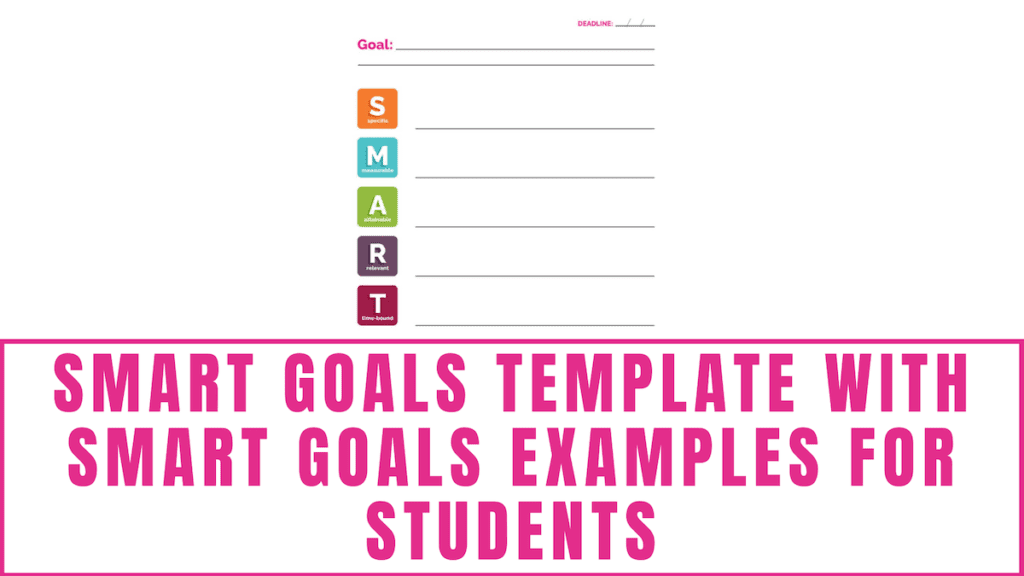
To use this SMART goals template, you’ll write your goal at the top. Then, you’ll ensure it’s actually a SMART goal by breaking it down into pieces.
Can you fill in how your goal is specific, measurable, attainable, relevant, and time-bound? If so, this goal passes the SMART test!
SMART Goals Example for Students
Still not 100% clear on what qualifies as a SMART goal? No worries, let’s look at a couple of SMART goals examples for students. (Keep in mind that SMART goals can work for anyone, not just students!)
SMART Goal Example for Students 1
Goal: Turn in all homework assignments for all classes by their due date during the last three months of the school year (April, May, June) to avoid academic probation.
This is a SMART goal because it is:
- Specific – All homework for all classes must be turned in on time.
- Measurable – Is any homework missing? If not, you’re on track to accomplish this goal!
- Attainable – It’s in your power to do your homework. You can control this! And there are tools that can help you stay on track, like the 13-page student planner.
- Relevant – You want to avoid academic probation.
- Time-bound – This goal spans just the last three months of the school year.
SMART Goal Example for Students 2
Goal: Over the summer (June, July, and August), read one non-fiction book each month to improve critical thinking skills and vocabulary.
This is a SMART goal because it is:
- Specific – It details how you will improve your critical thinking skills and vocabulary.
- Measurable – You will know if you read a book or not.
- Attainable – You can pick any non-fiction book you’d like, so this goal should be realistic. If you know August is going to be a busy month, you can pick a shorter book.
- Relevant – You want to improve your critical thinking and vocabulary.
- Tip: You could make this part of the goal stronger by adding why improving those things is important. For example, maybe you want to get into an AP course next year or think it will help you with writing college application essays.
- Time-bound – This goal spans just the summer months.
SMART Goal Example for Students 3
Goal: Complete and submit five college applications by November 15th to ensure consideration for early admission and the best financial aid package.
This is a SMART goal because it is:
- Specific – You will complete and submit college applications.
- Measurable – You will know if you have submitted 5 applications.
- Attainable – This goal is attainable, provided you set it far enough in advance. If you’re writing this goal on November 13, it probably is not attainable, but let’s assume you haven’t waited until the last minute to think about college applications! 😉
- Relevant – You want to be considered for early admissions and a strong financial aid package.
- Time-bound – This needs to be done by November 15th.
Tip: Depending on the components involved in your college applications, such as essays, letters of recommendation, and a portfolio, it may be smart to break this SMART goal into multiple smaller SMART goals.
For instance, perhaps you set a goal to request three letters of recommendation by October 15 and another goal to have the first draft of your admissions essay done by November 1. Breaking big goals down into more manageable chunks can prevent you from feeling overwhelmed or unsure of where to start with your goal.
Hopefully, these SMART goals examples for students have helped you see how to write strong SMART goals. What goals are you setting for yourself in the new academic year? Share your goals in the comments!
Happy SMART goal setting!


Leave a Reply
You must be logged in to post a comment.